
How to Evaluate Accounting Services
For most business owners and companies, the decision to add accounting services to their business represents a major step. It's usually driven initially by simple financial needs. Things like: Complex accounting or tax tasks that must be handled in a timely fashionGrowing revenue and payroll needs of the business (the...

For most business owners and companies, the decision to add accounting services to their business represents a major step.
It’s usually driven initially by simple financial needs. Things like:
- Complex accounting or tax tasks that must be handled in a timely fashion
- Growing revenue and payroll needs of the business (the bookkeeping simply becomes too much for the owner)
- A desire to better understand the financial position of the business
All of these issues (and many others) drive businesses to search for an ideal accounting partner. Here are some of the most important issues you need to look at, along with some tips about how to factor them into your evaluation.
Define Your Basic Needs
The first part of this evaluation is often the simplest. Most businesses have a need for basic functions like bookkeeping, processing payroll, filing essential tax forms, tracking deposits and withdrawals, and creating balance sheets (or just basic financial statements).
If these functions make up most of what you need, the most important part of your evaluation is finding a firm with a solid track record that can take these necessary activities off of your plate—instead of handling them in-house.
Look for great communication when you get specific with your evaluation questions, and try to size up the candidates to see if their bona fides match up well with your needs (things like the size of the firm, level of expertise, and communication skills).
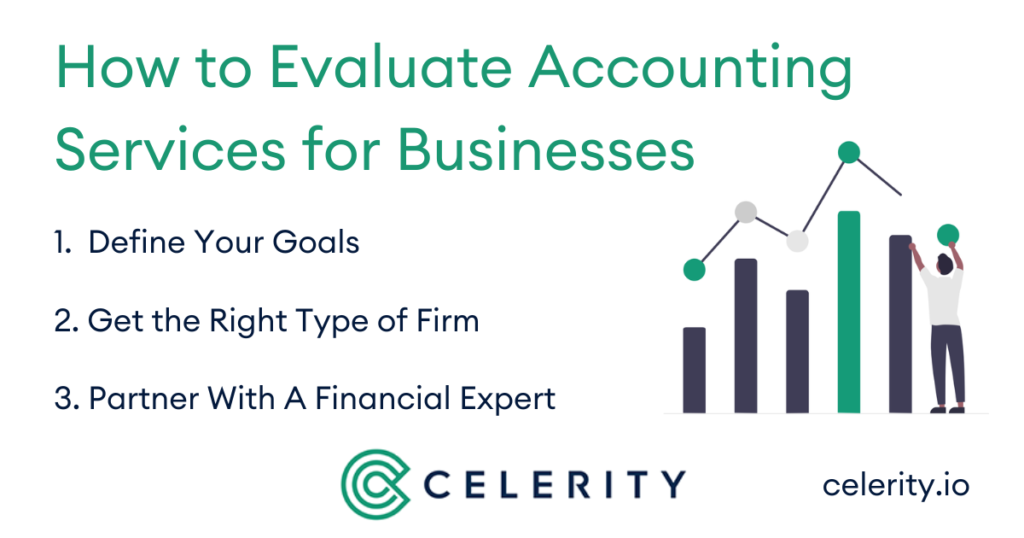
Define Your Goals
This one’s more complicated. It involves two broad steps.
- Defining specific metrics: Those pieces of data that show you how well you’re performing.
- Linking those metrics to business goals: For instance, tracking sales is great, but what about sales in comparison to a similar previous period? Being specific helps you really see how well sales grow. Or instead of tracking expenses after the fact, creating a detailed budget that’s tracked throughout the year. Doing so improves the likelihood you’ll stick to your budget.
Setting specific goals (tied to goals) requires asking pointed questions based on specific numbers, and it helps to break those questions down into specific areas (e.g, tax planning, business valuation, the kinds of reports you need, short-term and future recommendations, and so on).
You also need to know how this data is going to be presented and handled. Can it be done in a way that fits your situation, and can the professionals giving you things like financial statements and reports communicate the data effectively in a way that makes sense to you?
Asking these kinds of questions will give you a much better sense of fit. The right firm will give you answers that resonate, and they’ll be able to go beyond that and make suggestions that will help you grow in the future
Get Accounting Services that Fit Your Needs
Many business owners go into the evaluation process unaware of the different types of accounting firms they need to consider. This is important, so let’s provide a little background.
There are several types of accounting firms. Primarily, two types of firms handle the ins-and-outs of business accounting—outsourced accounting firms and public firms.
Outsourced accounting firm
Aside from the basic bookkeeping tasks (reconciliations, accounts payable, and receivable), an outsourced firm handles things like payroll, credit-related issues, preparing financial statements, and so on.
Asking them to go above this level can be problematic, so keep that in mind if you’re including these kinds of companies in your evaluation.
Public accounting firms
These firms focus on many of the same things as an outsourced firm, but what they do is usually broader and more complex. It includes services like analyzing data and information to cut costs and increase profits.
So if that’s a major need for you, you should definitely include them in your search.
Look for simplified pricing
Some firms rely on discovery calls and completely custom pricing. Others combine different types of services into a few easy-to-understand packages. Depending on how the firm(s) you’re considering prices their services, look closely at the specifics.
Also look carefully at other details of the firm including.
- Specifically, will you be dealing with a department, a team, or an individual?
- Are they too big and diverse to give you the individual attention you need, or will that size and diversity represent strength for you and your business?
- Will there be transparency in the relationship, and how will that work if that’s important to you?
The overall benefit of choosing an accounting service is great, no matter what level you need, from basic bookkeeping to controller-level services.
The Final Call for Accounting Services
Avoiding overwhelm is possible by doing a bit of research and understanding what you need to help your business achieve its goals. Celerity is ready to put you in the driver’s seat of your financial reporting and recordkeeping.
You’ll have full access and control because we do our work directly in Quickbooks Online. Ready to get started? Find out more about our services here, or get in touch with us today.





[…] it been a while since you opened your accounting software or spoke to your accounting solution? If you’re like most business owners, the answer is probably […]
[…] What to do: Reconciling your bank statements monthly is a good way to catch errors and prevent them from snowballing into bigger problems. You can do this yourself or outsource it to a professional. […]