
Using Intuit Enterprise Suite to Bridge the Mid-Market Gap
For a long time, the mid-market ERP conversation was pretty binary. If a client outgrew QuickBooks, the answer was usually NetSuite, Sage, or a heavily customized patchwork of tools. That was the jump. Expensive, complex, and often earlier than clients were truly ready for, but necessary if they wanted multi-entity...
For a long time, the mid-market ERP conversation was pretty binary.
If a client outgrew QuickBooks, the answer was usually NetSuite, Sage, or a heavily customized patchwork of tools. That was the jump. Expensive, complex, and often earlier than clients were truly ready for, but necessary if they wanted multi-entity visibility, dimensional reporting, and control.
However, that gap is starting to close.
Intuit Enterprise Suite(IES) has quietly crossed a threshold that matters to firms: it’s now comparable for a meaningful segment of mid-market clients. Not as an ERP replacement across the board, but as a step up from the typical General Ledger systems that’s a step towards ERP
The Real Problem: Mid-Market Complexity, Not Entry-Level Accounting
Mid-market companies require customization and lots of it. That’s usually the reason we’re moving away from something like QBO or Xero. Complexity makes using simple tools a painful task.
Most firms don’t struggle because they lack technical skill. They struggle because complexity scales faster than systems.
What firms see first:
- Clients adding entities faster than reporting can keep up
- Project profitability becoming critical, but hard to track in basic systems
- Month-end closes stretching longer and longer
- More manual intervention to keep numbers aligned
At a certain point, firms aren’t just doing accounting work, they’re trying to hold disparate systems together.
That’s where comparability matters.
As firms, we need platforms that let us:
- Standardize how complexity is handled
- Deliver consistent reporting across clients
- Reduce manual cleanup and exception handling
- Spend more time advising, less time reconciling
Historically, ERPs were the only real answer. IES now gives us an easier alternative.
Where Intuit Enterprise Suite (IES) Is Becoming Useful
IES stands out not because it adds features, but because it removes friction firms deal with every month.
Multi-Entity Management
Remember when we used to have to pull multiple business financials into a 10 tab excel file to consolidate? Well, I can happily say those days are behind us!
IES supports true multi-entity workflows in a single environment, which matters enormously for firms managing multiple complex clients.
For firms, this means:
- Fewer custom consolidation hacks
- More consistent intercompany treatment
- Cleaner month-end processes across the client base
Instead of reinventing the wheel client by client, firms can establish repeatable patterns.
Multi-dimensional reporting
One of the biggest pain points for firms is inconsistent reporting depth across clients.
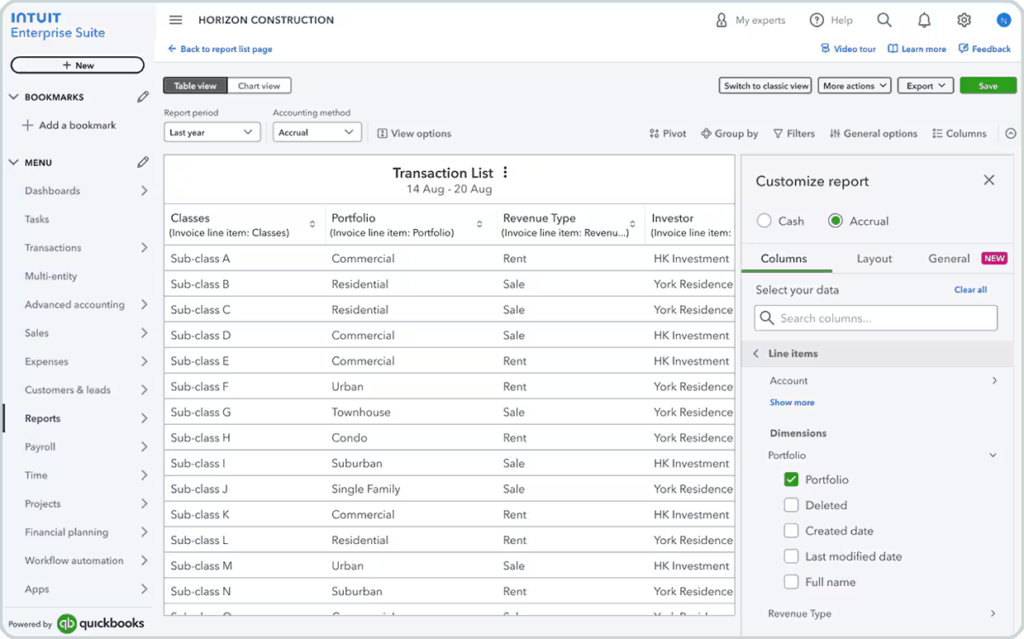
IES enables deeper, more consistent segmentation: entity, department, project, location without heavy customization.
That consistency allows firms to:
- Deliver more comparable reporting across clients
- Standardize advisory conversations
- Spend less time explaining how reports work and more time discussing what they mean
This is where firms start to operate more like advisory businesses, not cleanup crews.
Automations for our work
We’re getting automations similar to what’s in QBO but on an elevated level that I’m hoping becomes a way to really streamline multi-entity processes. Imagine having AI that could streamline automations across all your businesses, not just for each individually.
Automation only matters if it actually removes work.
IES uses AI-driven automation to:
- Speed up routine accounting tasks
- Reduce rework and exception handling
- Surface issues earlier in the close
The value starts to show up in running your firm too, not just for your clients. Automation helps accounting staff leverage their time better.
Better Project-Based Client Models
Intuit is focusing a lot more on construction going forward for IES and I know it’s one of their targeted industries for development in 2026. Projects are such a huge part of that!
For firms serving professional services, construction, or not-for-profit clients, project visibility is non-negotiable.
IES improves:
- Project-level tracking and forecasting
- Cost visibility without external tools
- Ongoing performance monitoring
This allows firms to deliver clearer answers around project profitability. In the past we’ve used band-aid workarounds for this. Intuit is working on making a more robust project accounting space in IES.
Growth Without ERP Implementation Headaches
IES gives firms a way to support growing clients without immediately stepping into full ERP implementations.
Clients get:
- Better structure and controls
- More reliable reporting
- Scalable workflows
Firms will avoid:
- Long implementation cycles
- Heavy customization projects
- High-risk & expensive transitions too early in the business cycle.
Staff doesn’t need to learn a new software anytime a client transitions. It’s built directly on top of QBO so it’s a small lift to switch.
How IES Fits Alongside Traditional ERPs
My firm works with ERP’s and the mid-market as a niche. We’ve all talked to prospects or have had those clients that need more than basic accounting BUT something like Netsuite would be absolutely overkill for. That’s where IES is fitting in.
IES isn’t a replacement for every ERP use case and firms shouldn’t position it that way.
Traditional ERPs like Netsuite still win when clients need:
- Lot’s of customization
- Advanced manufacturing or inventory complexity
- Highly complex global operations
Where IES stands out for firms is:
- Faster deployment (like 100x faster than implementing something else).
- Lower total cost of ownership.
- Strong integration across accounting, payroll, tax, and compliance.
- Less operational overhead to support and maintain.
IES fills the long-standing gap between SMB tools and full ERPs.
Ideal Client Profiles (From a Firm Perspective)
IES tends to work best for clients that are:
- Growing SMBs or lower mid-market businesses
- Operating multiple entities or locations
- Project-based or service-driven
- In industries like professional services, construction, or not-for-profit (for now)
- Asking more sophisticated questions of their financial data
- And lastly, companies who have lots of band-aids with their current solution.
If your firm is spending increasing time stitching systems together, that’s usually the signal.
Before recommending IES to any clients you should consider…
- Are you compensating for system limitations? If your team is doing manual work to keep reporting aligned, that’s a red flag.
- Is complexity increasing or being asked for?
- Does the client’s industry align with IES’s roadmap?
Mid-market clients want better insight.
Firms want better leverage & automations.
Intuit Enterprise Suite is now comparable enough in the mid-market to deliver accounting firms a new, practical lever for serving complex clients without forcing an ERP leap too early.
Learn more about how Intuit Enterprise Suite is designed to support accounting firms working with complex businesses.
This is a paid partnership with Intuit.





0